
Sound has been part of how I make sense of the world for as long as I can remember, although, perhaps strangely, my relationship with sound began with silence.
I grew up in a busy, noisy household and, even as a child, would seek out quiet places where I could simply be on my own. Later I found that same space in nature, sitting among trees, beside water, listening to wind, birds and all the small sounds that become noticeable when everything else quietens down.
I began to realise that silence was never really silent. There was always sound within it, and sometimes there were those remarkable moments when even those sounds stopped.
I didn’t have a therapeutic language for any of this. I just knew that it changed how I felt.
Music came next. As a teenager I discovered that I could use music to alter my emotional state: to lift myself, energise myself, settle myself or allow myself to feel something more deeply. Later, I spent several years working in and managing music venues, surrounded by loud, rhythmically driven music and people dancing.
That gave me a very different relationship with sound. I watched night after night as a strong repetitive beat changed a room full of people. Rhythm wasn’t simply being heard; it was being felt through the body, expressed through movement and experienced collectively.
Much later, psychotherapy gave me a framework for understanding some of what I think I had already discovered intuitively.
I have worked in counselling and psychotherapy since 2006, qualifying as a Gestalt counsellor and psychotherapist in 2008. My background includes Gestalt and Body Process Psychotherapy, clinical hypnotherapy and therapeutic supervision. Body Process in particular has meant that my therapeutic work has always been strongly somatic: interested not only in what somebody can tell me in words, but in sensation, movement, breath, tension, emotion and what the body may be communicating before words arrive.
Bringing sound into that work therefore felt less like adding a new therapy and more like extending something I was already doing.
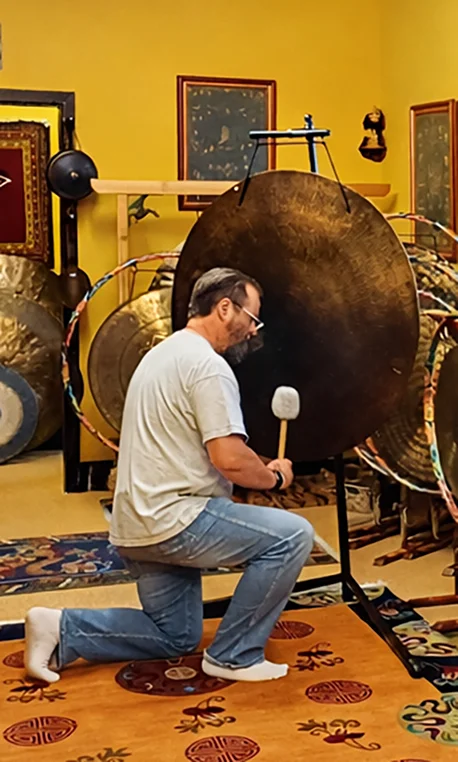
Sound, drum and gong
My interest in animistic and shamanic practice also goes back many years. I encountered the runes at seventeen and subsequently explored animism, shamanic practice, journeying and drumming long before I undertook formal sound-healing training.
I later trained as a Sacred Drumming Practitioner with the College of Sound Healing, followed by Integral Sound Healing training, and I am now an accredited College of Sound Healing practitioner and tutor. I have also undertaken the Gong Practitioner training and explored other approaches to therapeutic sound, including singing bowls, tuning forks and voice.
The two instruments at the centre of my own practice, though, are drum and gong.
I love the gong for its complexity. A single strike can open into an extraordinary landscape of vibration, harmonics and overtones. The sound grows and changes, interacts with the room and with the listener, and eventually dissolves back into silence.
The drum takes me somewhere different.
For me, it is perhaps the most grounded, earthy and elemental of sound instruments. It is one of humanity’s oldest instruments and connects us directly with pulse, rhythm, movement and body.
And yet it can be reduced to something wonderfully simple:
a beat and a space.
There is the acoustic vibration of the drum itself, but there is also the much slower frequency of the repeating beat, perhaps only a few beats each second in repetitive drumming.
And between every beat, however brief the interval, there is space.
Sound. Silence. Sound. Silence.
I increasingly find myself interested not just in the sounds we make, but in the silence from which they emerge and to which they return.
Intention
Central to all of my sound work is intention.
I don’t mean intention simply as deciding in advance that a particular thing should happen to somebody. For me it is subtler than that. It involves the quality of attention we bring, our state as practitioners, our purpose, our awareness of the other person and our sensitivity to what is actually happening in the space between us.
The same drum, rhythm or gong can be played in exactly the same technical way and yet be offered very differently.
That interests me enormously.
I’ve always studied quite widely, including subjects as diverse as physics, psychology, political philosophy and poetry at degree level. Perhaps inevitably, that means I tend to approach sound healing from several directions at once. I’m interested in vibration, resonance and what we can understand about sound physically, but equally in psychology, embodied experience, relationship, meaning, consciousness and those aspects of experience that resist easy measurement.
I don’t see those perspectives as needing to cancel one another out.
How I work
My approach is fundamentally relational, somatic and responsive.
I don’t want to impose an experience upon somebody or assume that a particular instrument, frequency or technique will produce a predetermined result. I am much more interested in attending to what is actually present, in the person, in their body, in myself, in the sound and in the relationship between us, and allowing the work to develop from there.
Sound isn’t simply a relaxation technique that I have bolted onto psychotherapy. For me, it is another way of encountering the whole person. Some experiences are readily available through conversation; others seem to become accessible much more easily through rhythm, vibration, resonance, movement and silence.
Alongside individual and group sound work, I facilitate drum circles and drum birthing ceremonies, and I make drums and Native American-style flutes. For me, making and playing aren’t entirely separate activities. Both involve materials, attention, listening and relationship.
I also play saxophone, badly, with considerable enjoyment, and with rather more enthusiasm than technique.
Alongside my sound and therapeutic practice, I teach counselling and psychotherapy and co-run Devon Counselling College with my wife, Jane, and whether I am working therapeutically, teaching, drumming or working with gong, the same themes seem to keep returning: body, rhythm, resonance, relationship, silence, presence and intention.
In some ways, after all the training, theory and exploration, I seem to have arrived back at something I first discovered as a child: sound emerging from silence, being experienced through the body, and eventually returning to silence again.
James offers
- Sacred Drum Healing
- One-to-one Gong Therapy
- Group Gong Baths
- Multi-Instrument Sound Therapy
- PsychoSonic Therapy